
Posted:
20 August 2026
Getting the whole school involved with CREST - a case study
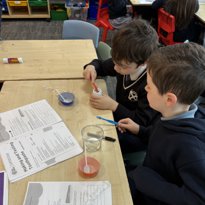
“It made sense for me to do [CREST] with the whole school; it gave us a progressive STEM plan.”
This is Gill Neeson, a teacher at St Andrew’s Primary School in Inverclyde, who spoke to us about St Andrew’s becoming the first school in Scotland to have all the pupils – 167 pupils - earn CREST Awards at the same time.
Gill heard about CREST during her two-year secondment as a Primary Science/STEM Development Officer for Inverclyde Council, when she advocated for other schools in the area to run CREST as an inclusive, effective way of engaging children with STEM.
On her return to St Andrew’s, she worked with the school to reimagine the curriculum, Gill said, “and we wanted to use STEM as a vehicle to invigorate it again. That was why I went with CREST.”
Gill added:
The fact that the CREST Awards are free to Scottish schools definitely made it easier to include all of our learners as we had no financial constraints.
The children aged 4-10 worked on CREST Star and SuperStar activities to earn their Awards, while the oldest pupils, aged 11 in the Primary 7 class, completed a more complex pizza project that they came up with themselves, to earn Discovery CREST Awards.
Gill spoke to us about aligning CREST with the Scottish curriculum, the importance of igniting a love for STEM in primary school, tapping into children’s interests and the benefits for children of having their hard work celebrated.
“I was able to align them to the Scottish curriculum”
As Gill teaches classes across all the year groups in the school, she was able to lead the STEM plan, and work with all the pupils on their CREST challenges during different lesson times.
CREST activities are designed to align with all the curricula in the UK, so that they can be part of lessons plans, as well as after school STEM clubs. Gill found this meant CREST could be embedded into lesson plans for years to come.
I was able to align them to the Scottish curriculum, so for the next time it's run…it's easier for staff to see where they would be taking that forward.
The CREST Resource Library offered support with this, Gill said:
There's the resource that shows you which activities go with which subjects in the curriculum. The fact that there was a mix of science, technology and engineering activities was great.
Gill planned for the younger children to complete eight activities, more than enough to earn a Star or SuperStar Award, including SuperStar challenge ‘Colorado brown stain’, a history-related challenge about fluoride and dental health “which caused a lot of hilarity with our primary 6-7 class”, Gill said.
The all-school CREST plan took place around the time of the Artemis II space mission in April, which inspired Gill to run her own activities around designing a lunar rover and landing crafts.
Running challenges from our Resource Library gave Gill the confidence, she told us, to design her own.
The Resource Library gives you that safety net at first to make sure that you were covering what CREST needed us to cover, and then you could see very quickly actually if I did [other activities], that would be covered.
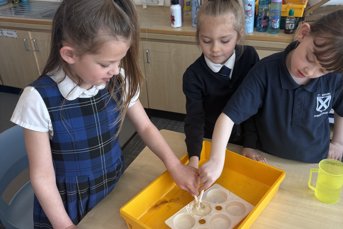
Pupils at St Andrew's taking part in a CREST challenge
“I think it's really important to instil that love of STEM in primary school”
Research by NUSTEM shows that “many children and young people from under-represented groups don’t see STEM as being done by someone like them” and that “before the age of eight young children make career limiting decisions about what they would and wouldn’t like to do when they are older”. So, engaging her pupils with STEM is incredibly important to Gill.
That was really what my role as Primary Science Development Officer for the council was about. I think it's so important for the children to see STEM as not a subject that is beyond them.
She continued:
I think it's really important to instil that love of STEM in primary school so that when they're going to secondary and they're choosing subjects, they've already got a love for the sciences and for their STEM subjects.
The idea behind primary CREST challenges is to show children that STEM can be exciting, hands-on and related to their everyday lives.
Gill found that this appealed to her pupils:
The fact that the CREST challenges were really fun activities made it more enjoyable for [the children].
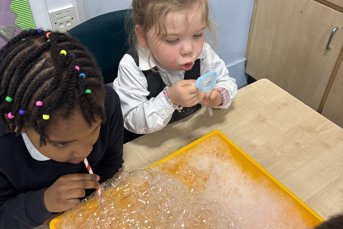
Pupils at St Andrew's taking part in a CREST challenge
“It's about knowing the pupils’ needs”
Running CREST with every pupil at St Andrews meant ensuring that learners with SEND were actively included. Earning a CREST Award is something every child can achieve with the right support.
For Primary 1 and 2, the classes for children aged 4-6 years old, having an extra pair of hands in the classroom makes all the difference, Gill said. “Making good use of the pupil support assistants”, she explained, allows all the children to be able to work on the CREST activities.
Adapting the work to be suitable for children with additional needs is key. CREST resources are inherently adaptable; the aim is participation, whatever form that takes. As long as the pupils are engaged and learning, they’re doing CREST.
“It's about knowing the pupils’ needs”, Gill said, “and the activities were so easily adaptable.”
For pupils who are advanced and keen to develop their skills, the CREST activities could be adapted to suit their abilities too.
It was easy to extend the learning for pupils that were needing a bit more challenge.
“[The pupils] were…showing people how to make pizza, which gave them a strong sense of pride.”
While the children in years Primary 1-6 (ages 5-10), worked on Star and SuperStar challenges, the Primary 7 pupils (aged 11) earned Discovery Awards for more complex work.
Gill told us that in this final year of primary school, it’s important to tap into pupils’ skills and interests to keep them engaged with STEM. After discussing ideas with the class, they settled on a project which would involve making and marketing their own pizza.
They were designing their logos, doing green screen adverts, designing the pizza boxes, and it was very much all about the end product being a pizza or making their own pizza - it was project-based learning.
This project gave the pupils the chance to see how STEM is intertwined with almost everything, including their favourite foods.
Designing pizza boxes aligned with the part of the maths curriculum that has learners making nets for 3D shapes, Gill told us.
After learning how to make pizza, the Primary 7 pupils worked with younger children in the school and members of the community, sharing both their newfound knowledge and some delicious treats.
We had a community event for us and our neighbouring school [The pupils] were making the pizza and showing people how to make pizza, which gave them a strong sense of pride.
The project kept the children engaged for that term, Gill said, and keen to find out what they would be doing next.

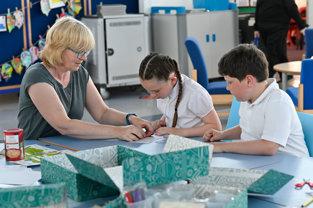
Pupils at St Andrew's taking part in a CREST Discovery challenge
“It really enforces that message that science is for everyone”
After enjoying the Discovery pizza project so much, the Primary 7 pupils were keen to keep cooking!
They asked to make no-bake cookies, Gill said, and she asked them, “what's the learning involved in that?” The children have to think about it and realise that mixing ingredients and seeing change is science learning.
I think when you're doing things like that, and you're getting them to think about it, it really enforces that message that science is for everyone. There's science everywhere in your everyday life.
“[Receiving CREST Award certificates] really validated the whole thing for them and brought it to life.”
At the end of the year, every single child at St Andrew’s Primary School was presented with a CREST Award certificate, to recognise their hard work and achievement. Certificates for Star, SuperStar and Discovery can all be pre-ordered as they’re teacher-assessed.
“We had an assembly and invited Gavin Brown, the Education Officer for Inverclyde, to present them”, Gill said.
She continued:
“We made a real big thing about it…and [the pupils] were all absolutely delighted. It really validated the whole thing for them and brought it to life.”
Do you know CREST Awards is free for all young people in Scotland?
From 20 August 2025, CREST Awards are completely free to for all young people aged 3–19 in Scotland, thanks to the generous support from the James Weir Foundation.
Other news and case studies
 Case studyPosted:28 February 2024
Linking primary and secondary science
 Case studyPosted:3 April 2025
SuperStar Kit Boxes case study
 Case studyPosted:10 September 2025
Making STEM accessible with Engage Grants
 Case studyPosted:2 July 2026
Inspiring learners with a CREST Star Kit Box
 Case studyPosted:3 June 2026
Enriching education with CREST Discovery