Posted:
3 June 2026
Enriching education with CREST Discovery
Our long-running partnership with Urenco involved a collaborating to design CREST resources, including ‘Enrich My Classroom’, a Discovery challenge that has young people aged 10-14 thinking about how they could utilise STEM to improve their surroundings.
For this case study, we spoke to secondary school science teacher Rebecca Mack to hear about her experience of running ‘Enrich My Classroom’ as a Discovery Day, and the rewards her students reaped from their work.
We also recently chatted to Rosie Salked, the Social Impact Lead at Urenco, about our partnership and any why Urenco were so keen to support CREST.
I don't want our boys leaving the school thinking that people only do science in a lab with test tubes. I don't want them to have that impression of what science is.
This is Rebecca Mack, a physics teacher and the STEM* lead at Loughborough Grammar School, an all-boys secondary school in the East Midlands of England.
Rebecca ran the Enrich My Classroom CREST Discovery challenge as an off-timetable day with her Year 8s earlier this year, to give them the chance to see that engaging with science isn’t just about learning facts and equations at a desk. It’s about discovering how STEM is interwoven into their lives, and getting creative with it.
Discovery challenges take around five hours to complete, and students work in teams to earn their Awards. For Enrich My Classroom, which was developed in partnership with Urenco, each member of the team goes to a different workshop in the morning to learn about a related topic. Then the teams come back together in the afternoon and use their collective knowledge to work on the final design challenge.
Rebecca spoke to us about why she chose this particular resource, how her students got involved and grew through working in a team, and why coming out of the classroom helped some students see science differently.
“I liked Enrich My Classroom because I wanted keep the challenge as broad as possible.”
There are several Discovery challenges to choose from in the CREST Resource Library; Rebecca chose Enrich My Classroom as she “wanted keep the challenge as broad as possible”.
It has the most variety in workshops, and also the most flexibility with their creative task.
For this challenge, students learn about topics including ergonomics, nanotechnology and coding in their workshops, then design an improved, futuristic classroom as a team.
While the workshops are set out in the Teacher Pack for the challenge, this is just guidance; CREST can always be adapted to suit the students. Rebecca explained that the boys had already been taught some coding, so the computing teacher running that workshop took the opportunity to teach them something different. “He went slightly off-piste,” Rebecca said, “and did something on cryptography instead, which was brilliant.”
Rebecca also chose this challenge too because it demonstrated to students how science is part of everything around us – encouraging them to a question a narrower definition.
STEM in their mind, sometimes it's just engineering. And then science itself is only something that you do in a science classroom…I'm trying to break that stereotype of what we mean by STEM.
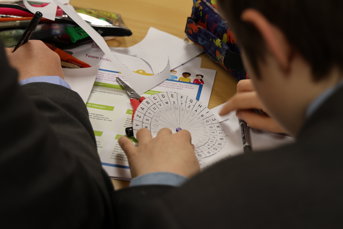
Students using a Ceasar cipher to explore cryptography
“They all took completely different approaches with [the CREST challenges]”
Being challenged to redesign a space they spend a lot of time in helped to engage the students; it’s directly related to their day-to-day lives and allows for lots of creativity and out-of-the-box thinking - something they might not have previously associated with science.
Rebecca told us:
Some of them had bits of kit, some of them had AI teachers, some of them had whole classrooms that did all sorts of wonderful things, but they all took completely different approaches with it.
At the ergonomics workshop, where they learned about redesigning pens and chairs to be more comfortable, “a lot of the boys that did it were really hooked”, Rebecca said.
I don't think it was something they've ever put much thought into before, and certainly not seen that as something that's STEM-related.
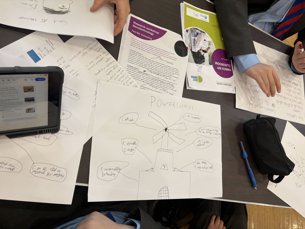
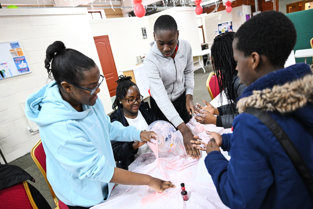
Preparations for the final project presentation
“They found the role descriptions in the student booklet were really helpful”
Once students had been put into teams, it was up to them to decide who would take on which role; researcher manager, engineer, designer etc. This gave them more autonomy over their project, and confidence in what they were bringing to the table. Rebecca told us:
They found the role descriptions in the student booklet were really helpful for them to know what they should be doing, and to feel secure in the role that they were given, which I think made them then feel comfortable contributing.
The set up of the day, each member of the team having gone to different workshops, also helped ensure each student was valuable:
I think because they'd all gone to separate workshops and come back, they were the only voice in that group that could advise on a certain thing. So they couldn't take a back seat and let somebody else do it.
“Off timetable days are always seen as something exciting…different and fun.”
Some students can have a mindset that science is not for them - they don’t feel excel in the right areas. Or perhaps they have a perception of what science is and have decided it doesn’t appeal to them, regardless of aptitude.
Some students, Rebecca found, “when they're in a science classroom learning science, they switch off…but off timetable days are always seen as something exciting…different and fun.”
Shaking things up by taking students out of the classroom lesson structure to do a CREST Discovery Day and giving them the opportunity to use different skills and see the real-world applications of STEM can make a huge difference.
“In the workshops, what was nice was they found their own niche”, Rebecca said.
Drawing, designing or presenting skills that they have that maybe they don't see relevant to science or STEM actually did become relevant [for the CREST Discovery challenge].
The ergonomics workshop in particular was ideal for students with artistic skills to see how they can be cross-curricular with science. Rebecca said:
In the ergonomics workshop, there were a couple of boys in that I know don't see themselves as scientists, but they were so involved with researching and designing a new chair because they got to get the colouring pens out and be really creative with it.
It also showed the students the importance of diversity within teams.
We don't all have to exactly the same skill set, and they were all able to use their skills in their own way.
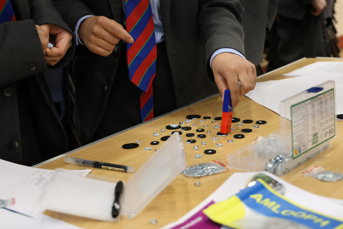
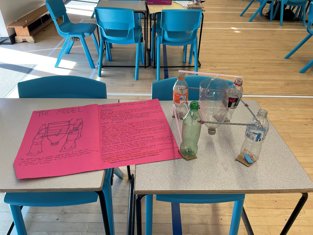
Magnetic and non-magnetic materials were used to create messages in binary code
“They do place quite a lot of value on [the certificates]”
Discovery CREST Award certificates can be ordered in advance to be given out to students when they’ve finished the final challenge. Rebecca’s students were presented with their certificates at their year group assembly.
Receiving certificates can mean a great deal to young people, and can help improve their mindset around science. Rebecca said:
It was great to see them all excited about having a certificate because they do place quite a lot of value on them…just having some sort of recognition that they're working really hard is nice.
After the success of this Discovery Day, Rebecca is planning to run it again next year with the new Year 8 cohort and has eyes on running Bronze projects in a similar way, perhaps over two or three days.
Loughborough Grammar already run Bronze CREST projects as part of the extracurricular chemistry club, but Rebecca is keen for to run Bronze with the whole year in lesson time. She wants to ensure boys who might not choose to work on a CREST project if it’s optional will still get the opportunity.
When STEM work is compulsory, Rebecca said, “they suddenly realise actually it is something they can do”.
Her key piece of advice to other teachers thinking about running a Discovery Day: do lots of planning and preparation ahead of time:
Plan the day in advance, but once you’ve done all the admin, the day runs itself.
*STEM is an acronym for science, technology, engineering and maths