
Posted:
16 November 2026
BookNest: a CREST Gold project in Dubai

The entire CREST process essentially makes you understand what you’re doing before you actually do it.
This is Aarav Vashnavi, a secondary student at the Dubai International Academy in the United Arab Emirates, speaking at our our first CREST global showcase webinar in October.
The webinar was a chance for educators and students based in India and Gulf Cooperation Council countries to share their experiences with CREST. Around 50 students were considered to speak at the webinar, Aarav was one of four students selected.
Aarav was selected to give a presentation on his project which earned him a Gold CREST Award, a downloadable app, BookNest, which is design to encourage users to read more – a fantastic example of how STEM can be cross-curricular with English.
We spoke to Aarav after the webinar to hear more about how the CREST framework helped him achieve his goal of designing and building a working app, the obstacles he faced along the way, and why he’d recommend it to other students.
“Students were slowly stopping [reading]…that's why I created BookNest”
Looking around at his friends and peers in the classroom, Aarav noticed that not many of them were reading. Conversations about favourite new books, authors and genres had begun to fall away.
People lack a place in which they can talk about their books and that can sometimes kill the anticipation of reading a new book.
For Aarav, a problem is an opportunity to make things better. He said:
Even the students who I knew like reading in previous years at school, they were also slowly stopping. I wanted to fix that… and that's why I created BookNest.
BookNest is an app that assesses the user’s reading level and interests, gives them AI-powered recommendations, allows them to track their reading and, perhaps most importantly, allows them to create forums to discuss what they’re reading with other users.
Building this would be no small feat.
Aarav knew he needed a framework to help him structure his ideas and plan out his work, and this was when he discovered CREST.
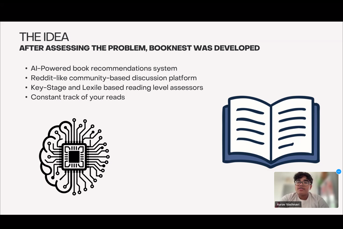
Still from Aarav's webinar presentation
When I finished [the CREST presentation], it allowed me to get a full map of what exactly I had done
Aarav used ChatGPT to find recommendations for a STEM project framework, and of all the options it suggested, CREST piqued his interest.
I looked through the CREST requirements and the whole structure, and I really liked it...Every step of the way it makes you question whether everything is coming together properly, especially through the presentation you have to make at the end.
Aarav had the dual tasks of designing and building BookNest, as it is a real working app, and creating a comprehensive presentation using the CREST framework laying out his process and progress, that he would submit to a CREST assessor.
He worked on them simultaneously, which he found helpful as, he told us, “I get more ideas while I'm doing the thing”.
He found that having a detailed log of his work in the form of his presentation outlining what he had done at every stage was hugely beneficial.
When I finished [the presentation], it allowed me to get a full map of what exactly I had done and how I did it. That was very useful to me because not only did it help me understand my app better without realising, it also helped me to explain to people. I was trying to like to link my app with our school library and that worked because of the presentation.
My prompting skills and my fine editing skills got much better
To build the app Aarav used a technique called vibe coding, a term coined by AI researcher Andrej Karpathy in early 2025.
Vibe coding ‘describes a workflow where the primary role shifts from writing code line-by-line to guiding an AI assistant to generate, refine, and debug an application through a more conversational process’.
It makes app-building more accessible and could become a more popular practice, letting people turn their app ideas into reality.
“Since I majorly vibe coded this app”, Aarav said, “I was able to improve my skills in it.”
Earning his Gold CREST gave Aarav the opportunity to work closely with AI and develop his understanding on how to get the best out of it.
I had to make different tweaks here and there to my prompts. I had to make small changes in the code itself. I had to make sure the AI knew what it was doing. My prompting skills and my fine editing skills got much better because of that.
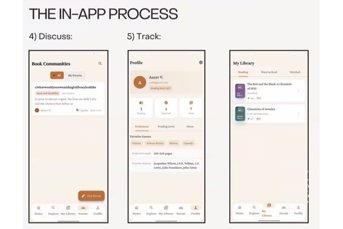
Still from Aarav's webinar presentation
I really like how [the CREST assessor] gives you very constructive, detailed feedback
The road to having a working app and a Gold CREST Award was not with always smooth for Aarav.
This first submission for the Gold Award was not successful, but this turned out to be an opportunity for improvement.
“I really like how [the CREST assessor] gives you very constructive, detailed feedback, because using that feedback I was able to create a perfect next submission that got accepted.”
He continued:
After it got accepted, I felt very happy because I put a lot of work into it. It’s very reassuring because they give you a breakdown of what parts of your project were good and what parts you could improve for the future.
[Doing CREST] opened me up to career prospects that I didn't really think of before
Aarav had an interest in using AI for computer science before he worked on his CREST project, he told us, “but then it was reinforced because I actually made something out of it.”
Because I made something out of it, I felt way more confident in my skills.
He continued:
It opened me up to career prospects that I didn't really think of before…doing this helped me open up to the world of financial modelling and financial regressions and all of those kinds of things, because those also require a lot of coding and a lot of AI.
To other students, Aarav says:
CREST is a very useful structure that I would suggest everyone to use, regardless of whether they’re applying for the certificate or not. It gives you a solid framework without forcing a subject. In a CREST gold project, you can literally do whatever you want. It allows you to build really strong projects.
Other news and case studies
 Case studyPosted:3 April 2025
CREST Awards for international students
 Case studyPosted:4 December 2024
Linking AI & healthcare - a Gold case study
 Case studyPosted:4 April 2023
CREST Awards can boost UCAS applications
 Case studyPosted:20 January 2023
Biscuit dunker for a CREST Award!
 Case studyPosted:10 October 2023
Hearing youth voice on mental health