Posted:
5 October 2026
Sea Cadets design lighthouse for SuperStar CREST Awards
CREST challenges and projects, while most often run in classrooms or at home, can fit in perfectly to any setting where learning happens.
Sea Cadets, a UK charity “that broadens horizons and creates possibilities through a different kind of adventure” by giving young people the chance to learn marine skills on and off the water, discovered this when they incorporated CREST into their activities.
Heather Williams, Director of Learning at Sea Cadets, spoke to us about how Junior Sea Cadets (aged 9-12) at the Edinburgh Trinity Unit all earned SuperStar CREST Awards for challenges based around designing and building model lighthouses.
Heather shared how the CREST framework for STEM learning - hands-on engagement that is relevant to young people’s lives - aligns with the Sea Cadets work of helping young people develop skills and creativity, and expand their knowledge of topics they’re passionate about.
Why did you decide to run CREST at the Sea Cadets?
We're always looking for opportunities that help young people develop skills, confidence and curiosity beyond the classroom. We recognised CREST as an excellent way to support and celebrate the learning already taking place across our units.
What appealed to us was how practical, flexible and accessible the projects and challenges are. Sea Cadets is all about learning by doing, whether that's building, investigating, experimenting or solving real-world problems.
CREST provides a recognised framework that fits naturally with that approach and gives young people a real sense of achievement for the work they complete.
How running CREST across such a large organisation work?
Sea Cadets provides a national framework for learning and youth development, but our units have the flexibility to tailor activities to the needs, interests and circumstances of their young people.
That local flexibility is one of our strengths. Volunteers know their cadets and communities best, so they're able to adapt programmes accordingly. The CREST framework works well because it provides clear outcomes, while allowing units the freedom to deliver activities in ways that suit their young people.
This means STEM learning can be integrated into existing unit training programmes while still working towards a nationally-recognised award.
Can you tell me about the SuperStar activities the young people took part in?
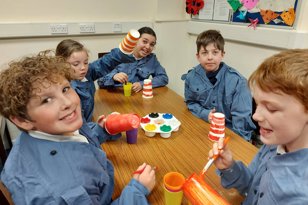
Marianne Sandison, Courses Officer at Edinburgh Trinity Sea Cadets, developed a lighthouse-building CREST SuperStar activity for junior cadets as part of a wider exploration of navigation and maritime safety.
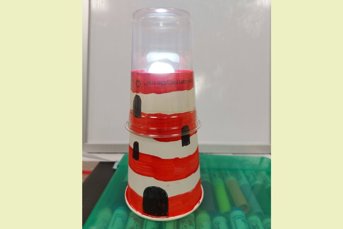
Using repurposed lifejacket lights, the juniors designed and built their own working model lighthouses. This STEM project helped cadets learn about the role of lighthouses, how sailors use light characteristics to navigate, and the differences between maps and nautical charts.
The project formed part of a longer-term learning programme in which cadets created their own charts and navigational systems, bringing together science, engineering, design and problem-solving skills.
Marianne found that the project-based approach particularly appealed to younger cadets, giving them the opportunity to build their knowledge over several weeks while developing confidence and independence.
It also offered a chance for the cadets to get creative. While some chose to model local lighthouses, others developed completely original designs. The result was a highly engaging activity that encouraged both technical learning and imagination.
Did you find it easy to adapt context-suitable activities to fit within the CREST framework?
Yes, very much so. In fact, many of the activities we already deliver through our STEM and training programmes naturally align with the skills and outcomes that CREST promotes.
The framework strikes a good balance between providing structure and allowing flexibility. It enables units to be creative and responsive to local opportunities while ensuring young people are developing key STEM skills and working towards a recognised achievement.
How were the activities designed to ensure neurodiverse children could take part and engage?
Inclusivity is a core principle at Sea Cadets, and we want to ensure every young person can participate fully and enjoy the experience of learning.
The practical nature of many CREST activities is particularly beneficial because it allows cadets to learn through doing, observing and discussing. Activities can be broken down into manageable stages, and volunteers are able to provide additional support where needed. We also encourage teamwork and offer different ways for cadets to contribute, helping each young person engage in a way that suits their strengths and learning style.
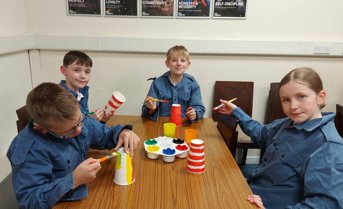
Sea Cadets in the Edinburgh Trinity Unit designing their lighthouses
Sea Cadets often operate in areas of deprivation with young people from low-income households. Do you notice the benefits for them of engaging with STEM outside school, and having their achievements recognised?
Absolutely. Many of our young people gain access to experiences and opportunities they may not otherwise have had through Sea Cadets.
STEM activities delivered in an informal, supportive environment can help build confidence and show young people that STEM is not just school subjects, but practical skills that relate to everyday life. We've seen cadets grow in confidence when they realise they're capable of solving problems, thinking creatively and achieving amazing things.
Having those achievements recognised through a nationally-respected award like CREST is incredibly valuable. It gives young people something tangible to celebrate and helps reinforce the belief that they can succeed.
Can you tell me about ordering and paying for the CREST Award certificates, how does it work for a big organisation?
We preorder CREST Award certificates centrally through our National Support Centre to use across the organisation. For a large organisation like Sea Cadets, this streamlined approach keeps administration to a minimum and makes the process easy for volunteers to manage.
The growth in participation speaks for itself. In 2025 alone, 836 CREST Award certificates were issued to cadets across the UK, and we’ve already handed out 476 certificates so far this year. This reflects both the enthusiasm of our young people and the dedication of our Junior Sea Cadet Instructors in delivering high-quality STEM experiences.
Are there plans for older Cadets to work on secondary CREST projects?
Definitely. We see CREST as a pathway rather than a single award; there is significant potential for older cadets to progress onto Discovery, Bronze and higher-level CREST Awards.
As cadets gain experience and confidence, they're increasingly encouraged to take ownership of projects, develop leadership skills and undertake more independent learning. The higher-level CREST Awards complement that progression extremely well.
Would you recommend CREST to other similar organisations?
Without hesitation.
CREST provides a flexible and engaging framework that works exceptionally well in a youth organisation setting like ours. It can be adapted to suit different environments, interests and resources, while still giving young people the opportunity to work towards a nationally-recognised achievement.
Most importantly, it helps inspire curiosity, build confidence and develop problem-solving skills. It allows young people to see themselves as creators, innovators and future STEM leaders, and that's something we'd encourage any youth organisation to support.