
Posted:
27 October 2026
Isabel Webb: 'CREST...helps young people translate what they learn in a classroom into something tangible and hands-on'
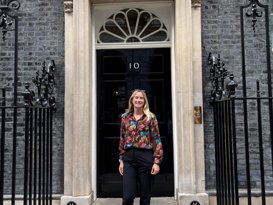
Isabel Webb is the Deputy Director for Technology Strategy and Security at what was previously known as the Government Department for Science, Innovation and Technology. When Isabel was in secondary school she earned a Bronze CREST Award.
She went on to become a PhD in Plant Microbiology, and, along with her department, she is working in partnership with CREST to develop a new Bronze resource.
We spoke to Isabel about her experiences of working on her CREST project, and how she has carried the skills she developed into her career in the STEM sector.
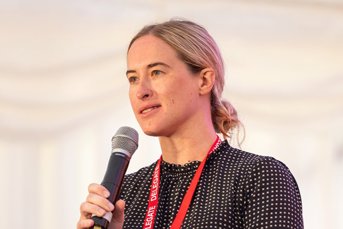
Dr. Isabel Webb
Can you tell us about your Bronze CREST Award? What did you explore for your project, and how did it expand your view of science?
I earned my Bronze CREST Award in 2005 as part of my school Science Club. My project was looking at different sweeteners compared to sugars, trying to look at their chemical properties using different tests.
I even took the experimenting home, and had a go at baking cakes with the different alternatives to see if they changed the taste and texture.
We took our results to a showcase at a local pharmaceutical company, and met students from other schools sharing their projects.
As part of the showcase we had the chance to tour some facilities and meet industrial scientists, which was one of my first chances to see science in a real-world applied setting and feel like there were great careers to pursue through science.
What skills did you gain and hone through working on your CREST project, and have you carried them into your career?
The CREST project was one of the first chances I had to work on a long term science project, including in collaboration with other students. I enjoyed being able to work together to come up with new ideas for experiments, and learn from the previous results to shape the project.
That’s absolutely a skill that I took forward into my PhD, and even a skill I still use today, although in a very different setting of policy making.
It helped me see that science can be both factual and creative, something I’ve always enjoyed about studying the sciences. Hearing about the projects that others were doing showed me how diverse a future in STEM can be.
Your department is working in partnership with CREST to develop a new resource. Why do you think programmes like CREST matter for young people today?
CREST, and similar STEM education programmes, help young people translate what they learn in a classroom into something tangible and hands-on. In lessons you learn the ‘how’ of experiments, but sometimes it’s hard to connect to the real world - ‘why’ you would do them. CREST helps to make that link between a protocol and an experiment, and helps understanding of what science is like outside of the curriculum. It’s also a great way to build confidence in trying new things, and presenting your work.
What advice would you give to young people who are just beginning to explore science, technology and innovation and trying to achieve a CREST Award?
Watch videos online and read books and find an area that really interests you to explore. Science is always more interesting if you are exploring something that sparks your curiosity and interest.