Posted:
20 October 2026
Simon Watt: CREST allows for independent thinking and discovery

Simon Watt is the Public Engagement Manager at University College London (UCL). He worked with the British Science Association, along with a team of researchers from Air Safety Programme at UCL, to develop the latest CREST resources, ‘Droplet Detectives’, that was released in late September, 2026.
This resource project is a partnership between the British Science Association and UCL and UCL Hospital. There are two resources, a Discovery challenge and a Bronze project, both giving students the opportunity to use their creative skills to come up with ideas and designs to make public buildings safer. They’ll not only learn about airborne illnesses, and how air filters, but also the role of STEM to develop solutions to real-life problems such as coming up with innovations can help reduce airborne illness spread.
We spoke to Simon to hear about why UCL were keen to partner with CREST, his experience of developing the resource, and why STEM resources that tackle real-world issues are effective at engaging young people.
What do you and your team hope young people will learn from the ‘Droplet Detectives’ resources?
We hope they feel connected to real contemporary science, and see that research has the ability to really change the world around us for the better. The resource invites them to ask the same kinds of questions our teams of researchers ask themselves.
CREST allows for independent thinking and discovery. There is real room for ambition. It also emphasises the importance of teamwork. This mirrors the importance of teamwork in our large multi-disciplinary team where, though we might be working on different aspects of the project, but we all have to be pulling together towards the same goals.
Why do you think engaging young people with real-world STEM is important, and why CREST was a good vehicle for doing that?
The UCL team’s research focuses on the spread of disease through water droplets in the air, with the aim of making hospitals safer places, but there are many other environments where the outputs of this research could also have an impact.
Technological advances in air filtration could work in other places where large groups of people congregate closely. Schools would be a prime example of this.
These young people have felt the effects on their homes, family and education of the COVID-19 pandemic. They saw their schools close. and so can understand the need to have mitigating strategies for the future. It is an environment that they’ll understand so much more than our research team, and so might be able to come up with some genuinely novel ideas.
What have you enjoyed most about working on this CREST resource?
Seeing the team of researchers here at UCL come together to share their enthusiasm was a real joy. Working with the British Science Association to create a resource that is so open and adaptable that will hopefully inspire a great many students to do their best.
CREST resources: Droplet Detectives
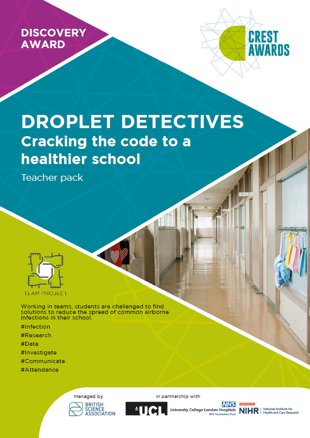
- This exciting Discovery challenge allows students to connect with the work of a real team of researchers at University College London. By taking part in a series of workshops, they will learn about strategies for redu...#Discovery#Infection#Research#Attendance
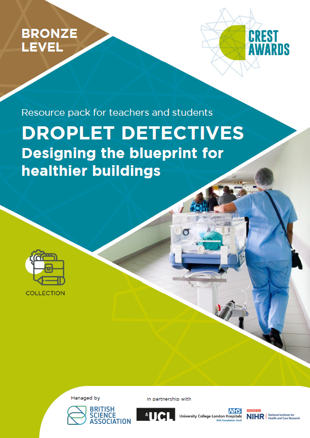
- This Bronze collection allows students to connect with the work of a real team of researchers at University College London. They will learn about strategies for reducing the transmission of airborne infections before...#Bronze#Infection#Research#Architecture#Design